
Digital Manufacturing
Digital Validation & Compliance

Integrated Validation & Compliance: Your foundation for Digital Manufacturing success
When modernizing and digitalizing manufacturing operations, validation is often the hidden bottleneck that slows innovation, reduces ROI, and limits success. At NNIT, we integrate validation into modernization programs to avoid delays and reduce compliance risks.
Digital manufacturing is only as strong as the data it produces. That’s why we build GxP and regulatory compliance into every stage of your project. Rather than validating systems after implementation, we apply a compliance-by-design approach that embeds requirements from the earliest project phases whether configuring a Manufacturing Execution System (MES), developing an Electronic Batch Record (EBR) solution, or upgrading your Laboratory Information Management System (LIMS).
A key part of this transformation is moving from documentation-heavy Computer System Validation (CSV) to a more efficient, risk-based Computer Software Assurance (CSA) approach.
Our validation and compliance expertise ensures end-to-end traceability across production, Quality Assurance (QA), and Quality Control (QC) processes supporting continuous audit readiness and stronger inspection outcomes.
Rooted in the pharmaceutical and biotechnology industries, NNIT combines IT fluency with deep expertise in OT, GAMP 5, 21 CFR Part 11, and Annex 11.
As an integrated component of our digital manufacturing services, we provide the framework to ensure your systems and processes are compliant by design not as a costly afterthought.
Our approach to resilient Digital Manufacturing compliance
You need more than a checklist to navigate the complexities of regulatory compliance, transformed workflows, and advanced technologies. You need a holistic strategy that aligns operational and commercial objectives, streamlines compliance, and reduces risk. Validation and compliance processes must also scale with your evolving requirements.
At NNIT, we bring global regulatory intelligence, deep technical expertise, and extensive life sciences experience to every engagement. We apply proven, risk-based methodologies designed to ensure compliance by design not as an afterthought.
-
Risk-based approach to GxP Digital Manufacturing validation
Transitioning from traditional Computer System Validation (CSV) to a Computer Software Assurance (CSA) approach.
Utilize critical thinking and a risk-based approach over documentation.
Adopt rigorous, scripted testing for high-risk functions (such as sterilization controls) and less intensive assurance methods for low-risk workflows.
Leverage vendor documentation with robust supplier assessments.
-
Compliance across the Digital Manufacturing stack
NNIT's expertise extends across the full manufacturing software stack.
Level 1 device (machines, sensors), Level 2 control (SCADA, PLCs), Level 3 operations management (MES, LIMS), and Level 4 business and planning (ERP, PLM).
Achieve horizontal integration across production, QA, QC, and supply chain, as well as vertical integration with Level 3 and Level 4 systems.
Validation of the digital thread between your systems, IT/OT convergence compliance, edge and cloud validation, and hybrid environment compliance.
-
Aligning Digital Manufacturing systems with ALCOA+ principles
Ensuring the data integrity gold standard where data is Attributable, Legible, Contemporaneous, Original, Accurate, plus Complete, Consistent, Enduring, and Available.
Utilize robust Identity and Access Management (IAM) protocols and 21 CFR Part 11 compliance e-signatures.
EBR solutions for real-time data capture and to reduce human error risks.
Develop Review by Exception (RBE) capabilities to ensure compliance without unnecessary work.
-
Continuous compliance for modern manufacturing
Providing you with the framework and tools to ensure your digital manufacturing systems stay compliant.
Manage patches, updates, and configuration changes in real-time.
Utilize automated testing frameworks to ensure changes or updates have not broken critical GxP functions.
Integrate change control directly into DevOps, ITIL, and OT workflows to ensure every change is risk-assessed and dealt with accordingly.
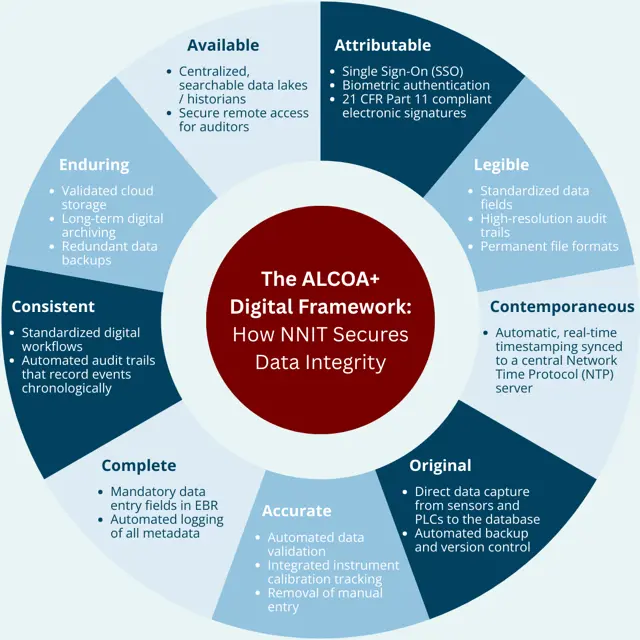
The ALCOA+ digital framework: How NNIT secures data integrity
-
Attributable
Digital implementation:
Single Sign-On (SSO)
Biometric authentication
21 CFR Part 11 compliant e-signatures
Benefit:
Eliminates shared passwords
Ensures every action is traced to a specific, verified individual
-
Legible
Digital implementation:
Standardized data fields
High-resolution audit trails
Permanent file formats
Benefit:
No more bad handwriting or faded paper
Records remain readable for decades
-
Contemporaneous
Digital implementation:
Automatic, real-time timestamping synced to a central Network Time Protocol server
Benefit:
Prevents backdating and memory errors
Records are created when events happen
-
Original
Digital implementation:
Direct data capture from sensors and PLCs to the database (Primary Record) with automated backup and version control
Benefit:
Ensures the source of truth is preserved
No manual transcriptions or risky paper processes required
-
Accurate
Digital implementation:
Automated data validation
Integrated instrument calibration tracking
Removal of manual entry
Benefit:
Helps ensure data reflects the true process conditions
Reduces human error and OOS (Out of Specification) findings
-
Complete
Digital implementation:
Mandatory data entry fields in EBR
Automated logging of all metadata
Benefit:
Prevents missing data points that often lead to batch rejection or audit observations
-
Consistent
Digital implementation:
Standardized digital workflows
Automated audit trails that record events chronologically
Benefit:
Ensures every batch follows the same validated path, regardless of the operator or site location
-
Enduring
Digital implementation:
Validated cloud storage
Long-term archiving
Redundant data backups
Benefit:
Protects records against physical damage, loss, or technological obsolescence
-
Available
Digital implementation:
Centralized data lakes / historians
Secure remote access for auditors
Benefit:
Significantly reduces audit preparation time by providing instant data retrieval
NNIT specializes in the life sciences sector and has extensive experience supporting pharmaceutical organizations. Regulatory compliance is an integral part of how we work and how we deliver projects.
We have broad experience with FDA, EMA, and other global regulatory requirements, enabling us to support digital manufacturing validation and compliance in both global programs and single-site initiatives.
Our experience spans the full value chain from clinical R&D and commercial manufacturing to post-market surveillance.
Key Features of our validation and compliance capabilities
-
Validation method (CSV, CSA)
Strategic transition from CSV to CSA.
Application of the intended use principle to apply critical thinking to the validation of digital systems.
Agile and digitalized validation processes.
Advanced testing methodologies.
Leveraging vendor and supplier documentation where possible.
Transitioning compliance processes from paper to glass.
-
Automated testing
Replace resource and time-intensive manual testing with a regulatory-compliant automation strategy.
No code / low code testing automation.
Cross-technology integration testing between fragmented systems.
Automated audit trails.
-
Documentation
Creating a lean, digital, and high-integrity data trail that demonstrates compliance in real time.
Transitioning from manual, paper-based protocols and workflows to digital systems.
Electronic Batch Records (EBR) and Device History Records (eDHR).
Implementing Review by Exception.
-
SOP and policy creation
Converting manual and paper-based SOPs to digital work instructions.
Eliminating manual data entry errors.
Ensuring SOPs are executed as part of an integrated digital process.
Authoring GxP policies that standardize compliance across multiple sites while allowing for local nuances in FDA, EMA, and other requirements.
Creating a Master Policy Framework for Digital Manufacturing.
-
Templates
Pre-configured GxP asset and document templates.
GAMP 5 structured templates, including for User Requirement Specifications (URS) and Functional Specifications (FS).
Risk assessment templates with common failure modes included.
Reusable IQ/OQ/PQ test frameworks to reduce the need for authoring test scripts from scratch.
Global master rollout templates.
Data integrity and ALCOA+ checklists.
-
Batch integrity and quality control
Electronic Batch Record (EBR) implementation to eliminate manual paper logs.
Review by Exception (RBE) protocols to flag deviations and audit trail anomalies.
Automated data attribution.
Unified audit trail management with a single source of truth.
Implementing 21 CFR Part 11 compliant electronic signatures.

At NNIT, compliance and operational technology expertise are central to our work in life sciences. Our consultants bring experience from regulated manufacturing, laboratory, and cleanroom environments not only IT delivery.
We operate globally, combining consistent standards with strong regional execution across Europe, the United States, and Asia.
Digital Manufacturing environments continue to evolve, and validation and compliance strategies must adapt accordingly. We integrate compliance directly into manufacturing systems and processes to support modernization while maintaining regulatory control.
By embedding compliance within your manufacturing landscape, we help safeguard product quality, patient safety, and your organization’s commercial objectives.
FAQs
-
What is the difference between CSV and CSA in digital manufacturing?
Computer System Validation (CSV) is the traditional approach to validating digital systems in the life sciences sector. It is a very document-heavy approach that treats everything the same (from low-risk elements to high-risk elements) and seeks to prove compliance through exhaustive evidence.
Computer Software Assurance (CSA) is the modern approach that is aligned with current FDA guidance and broader global regulatory expectations. It is risk-based rather than document-heavy. CSA involves using critical thinking to assess risk to patient safety and product quality. Functions that are higher risk go through more rigorous validation processes.
-
Is CSA mandatory for Life Sciences companies in 2026?
No, CSA is not mandatory. However, it is aligned with the FDA's current validation guidance. In fact, most regulators around the world recommend a risk-based rather than document-heavy approach to validation.
While it is not mandatory, CSA reduces the compliance burden in life sciences organizations.
-
How can we ensure data integrity?
Compliance-by-design is typically the best approach to ensure data integrity in manufacturing environments. ALCOA+ principles are also crucial. With ALCOA+ principles, data must be Attributable, Legible, Contemporaneous, Original, Accurate, plus Complete, Consistent, Enduring, and Available.
-
Can cloud-based manufacturing systems be fully validated?
A lifecycle-based validation strategy is required to maintain a validated state, particularly in cloud environments with frequent vendor updates.
-
What is Review by Exception, and how does it speed up batch release?
Review by Exception (RBE) is a quality control strategy that replaces processes where quality teams review vast amounts of data. With an RBE approach, quality teams only review exceptions, i.e., situations where the system has indicated that data points are outside validated limits.
-
How do we handle validation for legacy manufacturing equipment?
NNIT utilizes a range of IT/OT convergence strategies to validate legacy manufacturing equipment. This includes, for example, wrappers or edge devices to extract data from legacy systems (such as legacy PLCs).
Compliance Solutions For Life Sciences

